Having used Raspberry Pi computers for several years I always follow the rules regarding proper thermal management of the CPU and its peripheral heat-producing chips. The Pi-4 tends to get hot under load if it doesn’t have a decent heat sink with a fan.
I strongly suspect that even a small amount of fan vibration on a Shake installation could be registered as unnecessary noise, so I am wondering if there have been any thermal issues if the Pi-4 simply has the standard low-profile heat sinks attached to the appropriate chips on board.
It doesn’t look like there would be a lot of air circulation in the small space between the Pi-4 and the add-on Shake hat, but adding a small fan to the Shake case could create a problem if it is not perfectly balanced.
I would like to deal with any potential issues before my Shake kit arrives.
You are correct, a fan would create a lot of noise, even raising the noise floor enough that you would miss some detections. These devices are incredibly sensitive to vibration.
I have never correlated my Shake and Boom’s thermal profile with my shake detections. I have enough time with the device and hundreds and hundreds of recorded events of quakes large and small, many at distances over 10K miles, that I do not believe the lack of fan is an issue. My quake is currently covered with a box I made with faraday cloth to mitigate the much bigger issue you will also face; RF sensitivity. Depending on frequency, expect even very low (QRP) power levels to affect the sensor.
Good luck, I would be interested if you discover any heat effects.
If I were to provide some sort of cooling air stream, it would have to be delivered via a flexible tube from some sort of small vibration-isolated fan enclosure, where the tube does not come in contact with the RS case. But if your experience says there don’t seem to be any problems, it may just be a moot point.
Regarding RF susceptibility, I plan to enclose the kit’s acrylic case in a grounded metal outer case which will be lag-bolted to the house foundation wall, with RF-screened airflow openings. The DC power and CAT-8 network cables will have RF chokes. I learned this sort of stuff the hard way LOL.
Raspberry Pi’s are susceptible to RF, and since I use frequencies from 3MHz up to 5GHz, a bit of paranoia is useful. Just for interest, I will run a continuous shell script to log time-stamped CPU temperatures, maybe every 30 seconds or so.
One reason I’d like to use an external M.2 SSD is so I can keep lots of logged data before having to rotate the logs *IX style.
A lack of fan has not proven to be a limiting factor for Raspberry Shakes using RPi 4 boards (if you haven’t already, I recommend checking that your Pi4 board is one of the compatible ones, here) and you shouldn’t observe unusual behavior.
On the opposite side (and as you have already surmised), any fan/motor equipment in proximity of the Shake would create unwanted vibrations that would affect the data the Shake itself is recording. And, as a note, attempts to duct airflow from a more distant fan could also couple mechanical or acoustic noise into the enclosure.
If you want, you can apply passive cooling (I have tested it once, and the temperatures always stayed around 50°C during normal operations in a standard house room) with the usual small Pi-sized sinks (I have some neon orange/blue ones that do the job). As the Shake workload remains well below throttling levels, you’ll be able to run the instrument for years without thermal-related data quality issues.
The RF-proofing plan you have in mind is sound, and I’m curious to see how it’ll perform. We had another enthusiast that wrote a blog post regarding his RF-shielded valut, if it can be of interest. Amateur Radio & My RF Shielded Raspberry Shake Vault Experiment
I burned a 64GB Transcend High Endurance SD card with the latest image from github, and it simply worked.
To help a bit with thermal management, I deliberately underclocked the Pi-4 down to 1GHz from the normal 1.5. I have a script that runs at boot time to log CPU temperature, etc, once per hour. So far I have not seen anything above 57C, so it’s well within spec.
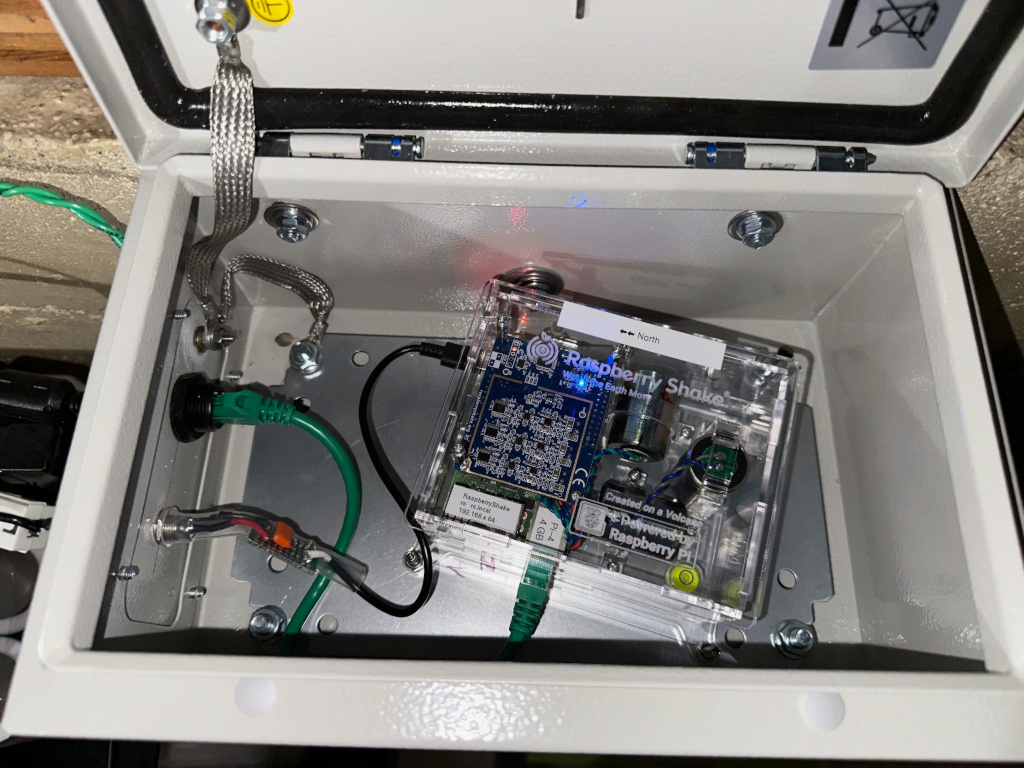
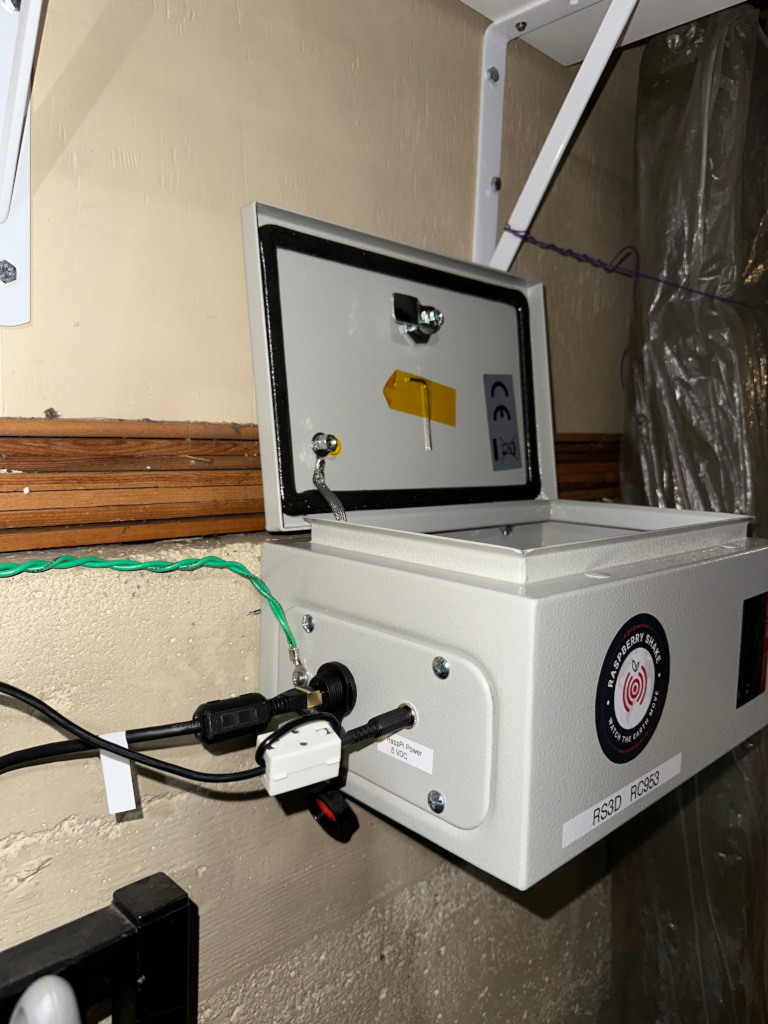
Here is the installation in a grounded steel RF shield box from Amazon, firmly bolted to the house foundation wall …
There are ferrite chokes on the LAN and power wires, and a bypass capacitor on the power leads just inside the box. The three levelling screws have their pointed tips sitting in small indentations drilled into the base plate to keep the 3D correctly aligned with true north.
This looks extremely professional; quite the job you’ve done! Welcome to the Shake family!
I love all the detailing you’ve thought of, from the aesthetics of the box to the CPU underclocking.
Only one thing, however, just as a heads-up.
As you have mounted the Raspberry Shake in a wall-attached enclosure above the floor, this can influence the recorded signals since walls can have their own vibration and resonance characteristics.
This may lead to some amplification of building-related motion or emphasize certain frequencies compared to a floor-coupled setup. The instrument will still function as expected, no question about that, but floor or ground placement typically yields measurements that are more directly representative of true ground motion.
Many thanks, that is very good to know! It’s too bad I don’t have a clear spot on the basement floor … too much stuff in the way - several large TrueNAS servers and KVM host servers, a ton of network switch gear, and shelves of miscellaneous electronics that hams like to collect. HiHi
So far the RS is working nicely, and using distance and propagation delay calculations I have already aligned a couple of obvious waves with USGS data on large quakes near Japan and Indonesia. It should be up and running 24/7, powered from a UPS.