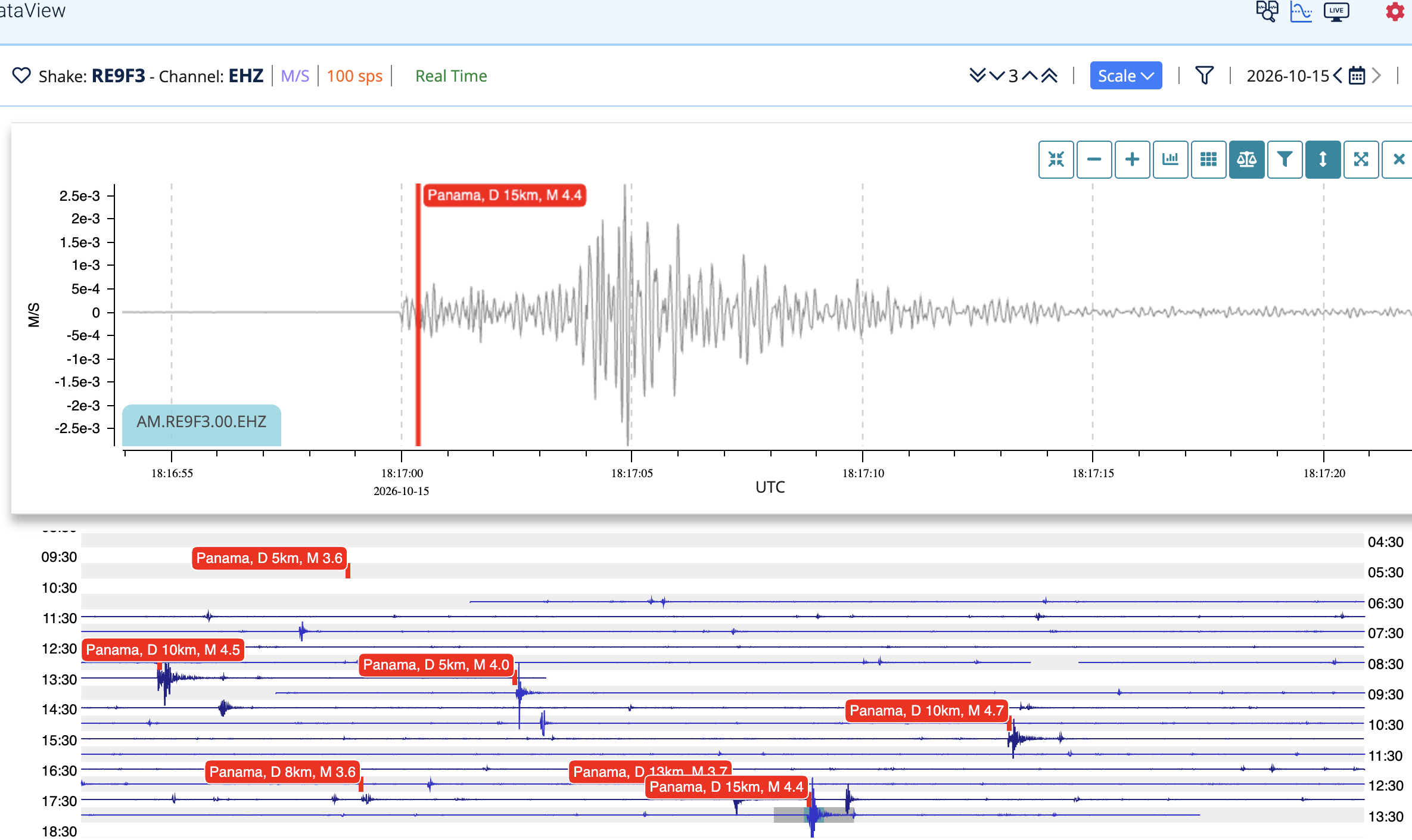
We continue to have lots of aftershocks in Panama, many 4+. Here is a recent one 29km from my station with no primary/secondary signature. Just one big wave. Is this common with aftershocks?
1 Like
By the way my station, RE9F3, is the closest Raspberry Shake in the Azuero to the Oct 9th M7.7. You find find it interesting to monitor aftershocks in real time. Its is really crazy here.
In these cases, it may be helpful to filter the waveform using a Regional or even a Global filter.
This is because these more restrictive bandpass filters can highlight individual waves better than the unfiltered view.
For example, if we use the M4.4 event you posted and filter it between 0.7 Hz and 2.0 Hz, we get this:

And the primary and secondary waves immediately become apparent. The primary (P) wave reaches the station at 18:17:00 UTC, while the secondary (S), with its larger amplitude, arrives about four seconds later, at 18:17:04 UTC.
The same can be seen from the spectrogram:

Where the S wave appears more prominently (in brighter yellow) compared to the initial P wave (more orange tones), at the same timestamps.
This also matches the rule of thumb for local earthquakes, where the distance (d) in kilometers between epicenter and station is roughly eight times the S-P time interval (Δt) in seconds (d ≈ 8 × Δt). In this case, it fits very well, being d ≈ 8 x 4 = 32 km, which is right what appears on StationView.
You can find more here: Seimic Waves and Earth’s Interior