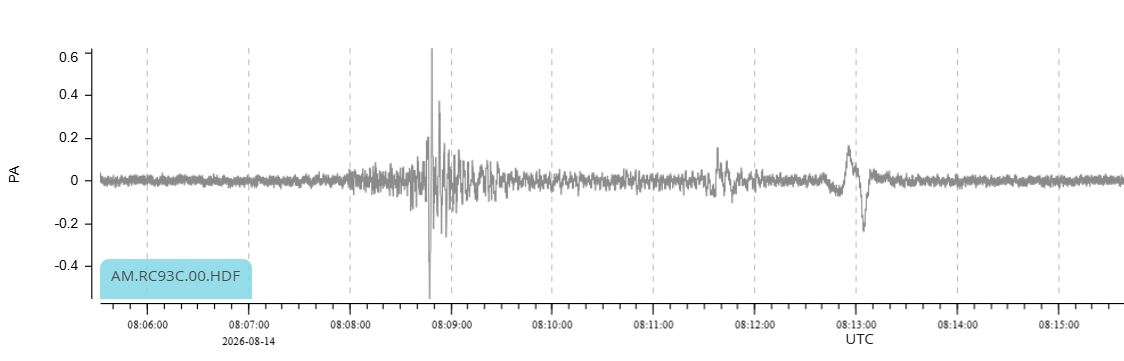
There was a bright bolide at 12:48 am PDT Aug.14 travelling from Soap Lake to Sim’s Corner, WA. USGS made a Facebook post with some traces from their volcano infrasound detectors, including on Oregon’s Mount Hood. I’m just south of Portland OR, about 203 miles from Soap Lake and 228 miles from Sim’s Corner. A rough estimate is 18 minutes for the sound to travel to me, suggesting 1:06 am. There was very little local wind noise, and my backyard soaker-hose setup (R-Boom AM.RC93C) picked up a pretty convincing signal above background between 1:08 to 1:13 am PDT (0808 - 0813 UTC).
1 Like
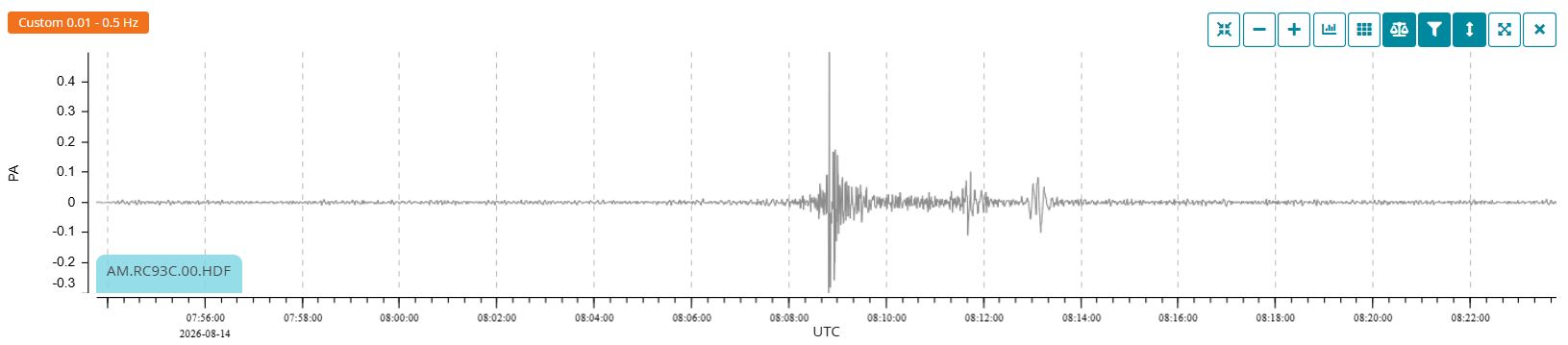
…although I will say I am wondering if the two features at 08:11:30 and 08:13:00 are related. When I look at a 30 minute period the signal is otherwise quiet so it seems very likely related, but what is happening there? Acoustic reflection off a mountain range? I do not see those later two features in the USGS trace from their Mt. Hood infrasound station, only the first main peak.
1 Like
Probably the cleanest sample I’ve seen here; a great capture by your infrasound setup!
I’d also lean towards the two downstream features you’ve highlighted as being associated with the event. As for their source, yes, they could have been generated by reflection, or maybe the meteor released two other pressure waves during its descent that were smaller than the first major one, but still detectable.
I could see at least two bright flashes in the videos I’ve managed to find, and since they usually precede major structural breakup and the release of pressure waves, that could support my hypothesis.
The “clean signal” part is maybe some luck about low wind speed locally. My R-Boom is just outside the house in a 8" concrete cinder block, with the inlet port connected to some 50’ of soaker hose that runs down into a ravine under tall trees. The hose itself is by now lying under maybe an inch of fallen leaves, which may add some attenuation of wind noise. My weather station on the house roof always shows lower wind speeds than predicted for the area, I suppose due to shielding effects of the surrounding hills and the tree cover.
I don’t know much about this field, but Claude AI sounds reasonable:
Sound velocity is on the order of 280–340 m/s for the stratospheric duct (stratopause at ~50 km) and 220–290 m/s for the thermospheric duct, versus ~340 m/s in the near-ground path. Over ~354 km, even a ~30–50 m/s difference in effective speed translates into several minutes of separation between arrivals. That matches secondary peaks with ~3 and ~4 min lag. Ducting is strongly directional, so other stations may be outside a detectable footprint of the later returns you see.
2 Likes